- Home
- Hardware
- SDKs
- Cloud
- Solutions
- Support
- Ecosystem
- Company
- Contact
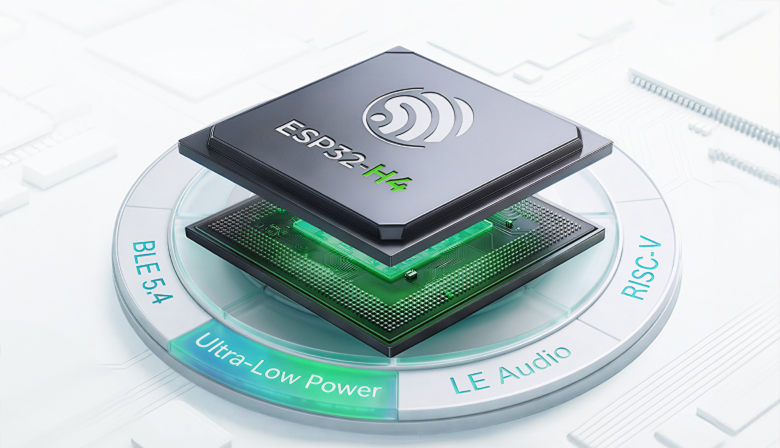

ESP32-H4 is a low-power dual-core 32-bit RISC-V SoC combining Bluetooth 5.4 (LE) and IEEE 802.15.4 connectivity with robust security and flexible memory support. Designed for long-life, energy-efficient operation, it powers a wide range of applications including wearables, wireless audio products, healthcare devices, and large-scale low-power sensor networks.
Features

Wireless Connectivity and Bluetooth 5.4 (LE)
Multi-protocol wireless connectivity for low-power mesh networks
ESP32-H4 integrates Bluetooth 5.4 (LE) and IEEE 802.15.4 in a single SoC, fully supporting all features of the Bluetooth 5.4 (LE) core specification and certified with Bluetooth 6.0. The Bluetooth subsystem supports advanced capabilities, including LE Audio, LE Isochronous Channels (BIS/CIS), Connection Subrating, Periodic Advertising with Responses (PAwR) and Direction Finding (AoA/AoD). These features enable low-power audio products, indoor positioning and large-scale beacon and sensor deployments. The 802.15.4 subsystem supports Thread 1.4 and Zigbee 3.0, enabling Matter-over-Thread and other mesh-based applications.

System and Memory
Dual-core RISC-V performance with flexible memory expansion
ESP32-H4 is built around dual-core 32-bit RISC-V microcontroller running up to 96 MHz with integrated DSP extensions. It includes 384 KB SRAM and 128 KB ROM, with support for external memory. The SoC also supports external PSRAM, allowing developers to run memory-intensive applications, such as LE Audio buffering, complex protocol stacks, data logging or sensor fusion. This flexibility simplifies application development and improves future-proofing for feature upgrades.

Low-Power Operation with Integrated DC-DC
Optimized power efficiency for long-lasting battery-powered devices
ESP32-H4 is optimized for ultra-low power operation. An integrated DC-DC converter improves overall efficiency through lower supply voltage and efficient power regulation. Combined with multiple low-power modes and selective peripheral activation, the ESP32-H4 enables devices to operate for extended periods on small batteries, such as coin cells or rechargeable packs. A reduced maximum transmit power further lowers RF current consumption, while Bluetooth LE optimizations—such as advertising without CPU involvement—make ESP32-H4 well suited for battery-powered sensors, wearables, LE Audio accessories, and Matter-over-Thread devices.

Affordable Security
Essential hardware security for cost-sensitive IoT designs
Aligning with Espressif's philosophy of affordable security, ESP32-H4 integrates secure boot, memory encryption, digital signature (ECDSA), cryptographic accelerators, and a true random number generator. These hardware security features protect private keys and sensitive data, enabling secure communication and firmware integrity, even in cost-sensitive designs and helping developers meet modern IoT security requirements.

Optimized Peripherals and Human-Machine Interaction
Rich peripherals and touch support for intuitive user interaction
ESP32-H4 offers up to 40 GPIOs, encompassing standard microcontroller peripherals such as I2C, I2S, SPI, UART, LED-PWM, ADC, Timers, DMA, TWAI, USB-OTG and MCPWM. Specialized peripherals include the Event Task Matrix (ETM) for automation-triggered tasks. With 15 touch-sensing GPIOs, ESP32-H4 is ideal for human-machine interaction devices, such as touch panels, smart switches, control knobs, etc.

Software Availability
A mature software ecosystem to accelerate product development
ESP32-H4 is fully supported by Espressif's open-source ESP-IDF platform, giving developers access to a mature SDK, tools and extensive documentation. For Bluetooth Low Energy development, it integrates seamlessly with Espressif's Bluetooth LE software ecosystem, including ESP-BLE-MESH and ESP-BLE-AUDIO, helping developers accelerate productization across a broad range of BLE applications. Additionally, ESP-Matter will provide support for ESP32-H4, enabling the development of battery-operated Matter-enabled devices with Thread connectivity. For customers using ESP32-H4 as a connectivity co-processor, firmware solutions such as ESP-AT and ESP-Hosted can also be used.